Air Conditioning vs Ceiling Fans in Benahavís: What Does It Really Cost to Keep a Home Cool?
A practical, lifestyle-led look at summer cooling costs in a 100 m² three-bedroom apartment — comparing central air conditioning, ceiling fans and modern aerothermia systems on the Costa del Sol.

Summer comfort is one of the quiet luxuries of owning a home in Benahavís. The long sunny days, warm terraces and open Mediterranean views are part of the appeal, yet when July and August arrive, the way a property is cooled can make a noticeable difference to both comfort and running costs.
For many homeowners and buyers, the question is simple: is it cheaper to run central air conditioning, or would ceiling fans be enough? And with more modern homes now offering aerothermia, is this newer system a better, healthier and more efficient option?
To make the comparison realistic, let us use a typical 100 m² three-bedroom apartment on the Costa del Sol. In one version, the apartment uses central air conditioning. In the other, it has ceiling fans in each of the three bedrooms plus one in the lounge. The exact cost will always depend on the property’s insulation, orientation, glazing, usage habits, electricity tariff and system efficiency, but the difference between the options is still very clear.
Working assumption for this guide: we have used an illustrative electricity cost of €0.20 per kWh. In Spain, the real price can vary significantly depending on the tariff, time band and contract type, so the figures below should be treated as a practical guide rather than a fixed bill prediction.
If you are planning a summer stay, you may also find our guides to summer weather in Benahavís and keeping cool in Benahavís helpful.
The Cost of Running Central Air Conditioning
Central air conditioning cools the apartment by actively removing heat from the indoor air. It can transform the feel of a home very quickly, especially during still, humid evenings or heatwave periods when natural ventilation is not enough.
For a 100 m² apartment, a central ducted system might average somewhere between 1.5 kW and 2.5 kW while cooling, depending on the outside temperature, the thermostat setting and how well the home holds its temperature. On very hot days, or if the system is older, poorly maintained or set very low, consumption can be higher.
Moderate summer use
1.5 kW average load x 8 hours = 12 kWh per day
12 kWh x €0.20 = €2.40 per day
Approximate monthly cost: €72
Heavier summer use
2.5 kW average load x 8 hours = 20 kWh per day
20 kWh x €0.20 = €4.00 per day
Approximate monthly cost: €120
During a heatwave, if the system is used for longer hours or set to a low temperature, the cost can rise further. For example, a 3 kW average load for 10 hours per day would use around 30 kWh daily, or approximately €180 per month at €0.20 per kWh.
The main advantage is comfort. Air conditioning lowers the actual room temperature, reduces humidity and creates a controlled indoor climate. For people who work from home, sleep badly in the heat, have young children, welcome summer guests or own a west-facing property, this can be worth the extra cost.
However, air conditioning is not just a question of electricity. Filters need cleaning, ducts and units need servicing, and poor maintenance can reduce efficiency. A system that smells musty, struggles to cool or has not been cleaned for years may cost more to run and feel less pleasant to live with.

The Cost of Running Ceiling Fans
Ceiling fans work in a completely different way. They do not cool the air itself. Instead, they move air across the skin, helping perspiration evaporate and making the room feel cooler than it actually is.
For our 100 m² apartment, let us assume four ceiling fans: one in each bedroom and one in the lounge. A typical ceiling fan might use around 50 watts on a normal setting, although efficient models can use less and larger or older fans can use more.
Ceiling fan example
Four fans at 50 watts each = 200 watts in total, or 0.2 kW.
If all four fans ran for 8 hours per day:
0.2 kW x 8 hours = 1.6 kWh per day
1.6 kWh x €0.20 = €0.32 per day
Approximate monthly cost: €9.60
Even if each fan used 75 watts, the total would be 300 watts. Used for 8 hours a day, that would be 2.4 kWh per day, or around €14.40 per month.
This is the central point: ceiling fans are dramatically cheaper to run than air conditioning. In our example, the fans might cost roughly €10–€15 per month, while central air conditioning could easily cost €70–€120 per month during regular summer use, and more during periods of intense heat.
The limitation is equally important. Fans improve perceived comfort, but they do not reduce the actual temperature. If the apartment has built up heat all day, if the terrace doors have been left open in the afternoon, or if the indoor temperature is still 30°C at midnight, fans may simply move warm air around.
Comfort Is Not Only About Temperature
In Benahavís, the best cooling strategy often begins before the air conditioning or fans are switched on. Shutters, curtains, awnings, pergolas, cross-ventilation and good glazing all have a major impact.
A shaded east-facing apartment with good airflow may remain comfortable with ceiling fans for much of the summer. A west-facing apartment with large glass doors and afternoon sun may need air conditioning almost every day in July and August. A penthouse with exposed roof space can behave differently again, while a lower-floor apartment surrounded by greenery may stay naturally cooler.
This is why buyers should not judge cooling by system type alone. Orientation, construction quality, window specification, terrace depth and the ability to create natural airflow all matter. When comparing homes, it is worth asking how the property behaves in August, not just whether it has air conditioning listed in the specification.

The Lifestyle Difference
Ceiling fans bring a soft, quiet, resort-like feel to a home. They are particularly pleasant in bedrooms, covered terraces and open-plan living spaces where the aim is to create gentle air movement rather than a sealed, artificially cooled environment. They are inexpensive to run, simple to maintain and often visually attractive when chosen well.
Air conditioning offers a different kind of luxury: certainty. It allows the owner to control the indoor climate regardless of outside conditions. It is particularly useful in homes used by international guests, families arriving in August, or owners who expect the apartment to feel fresh the moment they walk in.
The ideal arrangement is often not one or the other, but both. Ceiling fans allow owners to raise the air-conditioning set point by a degree or two while still feeling comfortable. That small behavioural change can reduce cooling demand, especially overnight. In bedrooms, many people find that using a ceiling fan with air conditioning set at 25°C or 26°C feels more comfortable than air conditioning alone at 22°C or 23°C.
Is Aerothermia Cheaper?
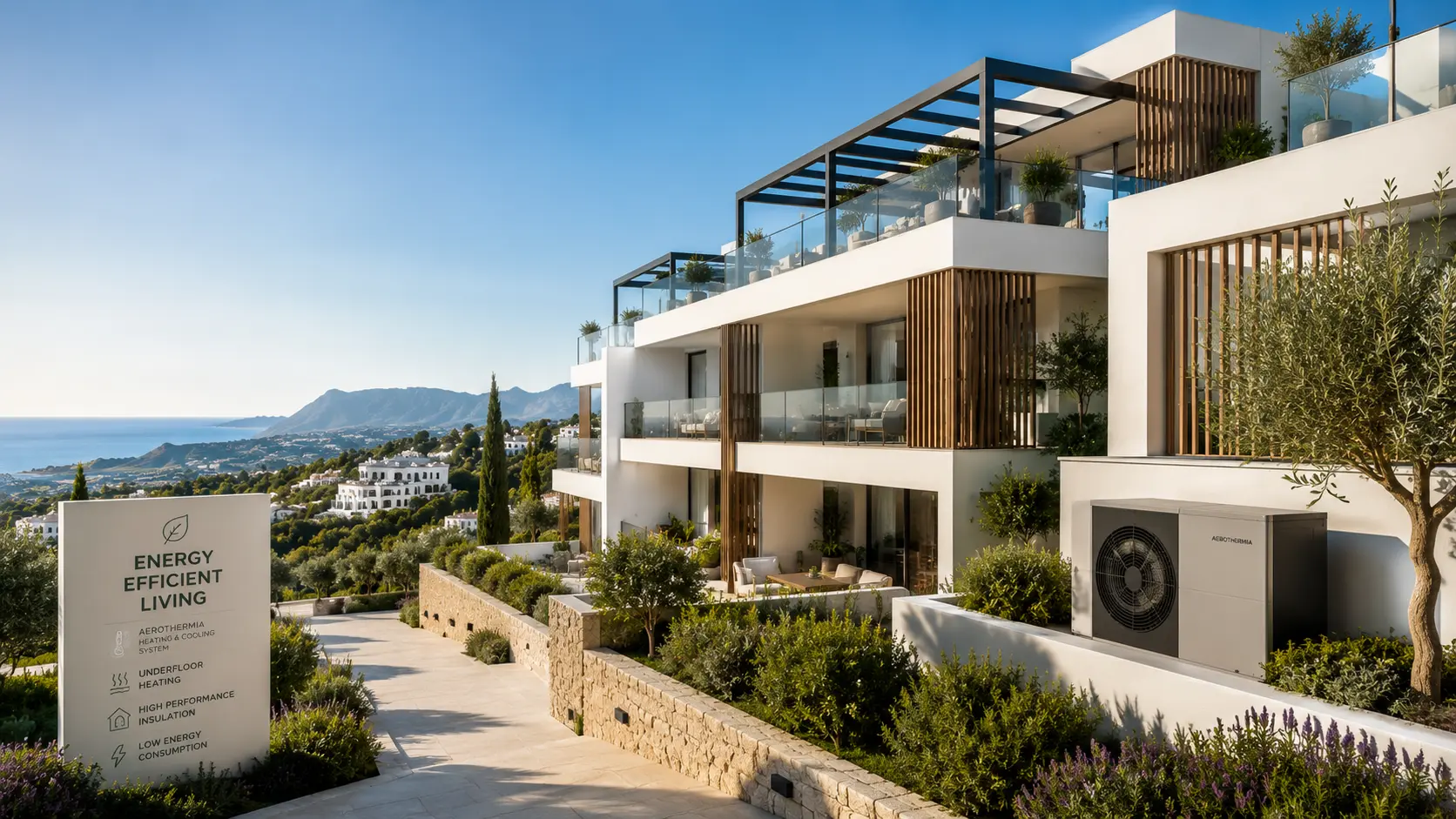
Aerothermia is becoming increasingly common in modern Costa del Sol developments. In simple terms, it is a heat pump system that extracts energy from the outside air and uses it for heating, cooling and, often, domestic hot water.
The word can be confusing because many conventional air-conditioning systems are already heat pumps, particularly modern reversible units that provide both cooling and heating. In Spanish property marketing, however, aerothermia usually refers to a more integrated air-to-water system, often connected to underfloor heating, fan-coil units or domestic hot water production.
Aerothermal systems can be highly efficient. Rather than creating heat directly, they move heat from one place to another. In heating mode, this can make them far cheaper than traditional electric radiators or older electric water heaters. In cooling mode, the savings depend on the design of the system, the emitters used, the insulation of the property and the thermostat settings.
For a well-designed 100 m² modern apartment, an aerothermal cooling system might use noticeably less electricity than an older ducted air-conditioning system, especially if the home is well insulated and the system runs steadily rather than constantly switching on and off. A reasonable working estimate might be €40–€80 per month for regular summer cooling, although real bills can fall outside that range.
The main benefit of aerothermia is not simply that it is “cheaper than air conditioning” in every case. Its strength is whole-home efficiency. A good aerothermal system can provide cooling, winter heating and hot water from one efficient platform. For full-time residents, this can make a substantial difference across the year.
Is Aerothermia Healthier?
Aerothermia is not automatically healthier than air conditioning, but it can form part of a healthier indoor environment when designed and maintained properly.
A good modern system may provide stable temperatures, avoid extreme blasts of cold air and work well with controlled humidity and filtration. If paired with proper ventilation, clean filters and sensible maintenance, it can feel more comfortable and less drying than poorly used air conditioning.
However, the same basic health rule applies to every cooling system: maintenance matters. Dirty filters, stagnant ducts, blocked condensate drains and neglected units can harm indoor air quality. Equally, a perfectly efficient system does not replace fresh air. Homes still need sensible ventilation, especially in the cooler parts of the day.
Ceiling fans, by contrast, do not filter or dehumidify the air. They simply move it. That can be pleasant and healthy in a naturally ventilated home, but it will not help with pollen, dust, humidity or indoor pollutants unless the home is also ventilated and cleaned properly. This is particularly relevant for owners who are sensitive to pollen or seasonal irritants; our guide to hay fever in Benahavís looks at this local issue in more detail.
Which Option Is Best for a Benahavís Apartment?
For occasional use, shoulder seasons and naturally cool homes, ceiling fans are extremely cost-effective. They are cheap to run, visually elegant and ideal for bedrooms where gentle airflow is often enough.
For peak summer, rental guests, west-facing properties or homes used by people who need predictable comfort, central air conditioning remains the stronger solution. It costs more, but it actually lowers the room temperature and controls humidity.
For newer homes, especially those designed for year-round living, aerothermia is usually the most complete and future-facing option. It can reduce energy consumption across heating, cooling and hot water, particularly when paired with good insulation, quality glazing and sensible controls.
The most refined answer is often a layered approach: keep heat out with shading, use natural ventilation in the morning and evening, install ceiling fans for low-cost comfort, and reserve air conditioning or aerothermal cooling for the hours when the home genuinely needs it.
In a Benahavís home, true comfort is rarely about one machine. It is about architecture, orientation, airflow, shade and intelligent use. The best homes feel cool not because they fight the climate all day, but because they are designed to live beautifully within it.
Calculation Notes & External References
These figures are intended as practical examples, not fixed utility-bill predictions. Actual running costs will depend on your electricity tariff, the outside temperature, how long the system is used, the thermostat setting, the age and efficiency of the equipment, and the design of the property.
- Electricity rate used: €0.20/kWh, chosen as a realistic working assumption for Spain. Eurostat data gives useful context for household electricity prices across the EU and Spain: Eurostat electricity price statistics.
- Ceiling fan consumption: traditional ceiling fans often use around 50–75 watts, although efficient models can use less. See this overview from Panasonic: ceiling fan power consumption.
- Aerothermia: IDAE explains aerothermal heat pumps as systems that extract heat from the natural environment and, when reversible, can transfer heat out of the building for cooling: IDAE aerothermal and hydrothermal energy. Iberdrola also describes aerothermal systems as providing heating, cooling and hot water: what is aerothermal energy?
- Indoor air quality: the EPA recommends ventilation, moisture control and appropriate filtration as part of a healthier indoor environment, including keeping humidity broadly between 30% and 50% where possible: EPA indoor air quality guidance.
Looking for a Comfortable Home in Benahavís?
Cooling systems matter, but so do orientation, shade, terrace depth, glazing, ventilation and build quality. If you are comparing homes in Benahavís, we can help you look beyond the brochure specification and understand how a property may actually feel during summer.